

How we review it
Your documents come first
Here is what we look at, in order.
- 01
Eligibility audit
Review the DLI, exact program, credential, study length, transfers, leaves, part-time terms and study-permit application date.
- 02
Language and field check
Confirm the required test level and whether the CIP code appears on the current eligible-field list.
- 03
Status and timing plan
Calculate the application deadline and determine whether the applicant can work while the application is processed.
- 04
Submit and preserve evidence
File the correct documents and retain proof of submission, completion and status.
In plain terms
What is a post-graduation work permit?
A post-graduation work permit, or PGWP, is an open work permit for some graduates of eligible Canadian programs. It can let you work for most employers, but graduating from a designated learning institution does not automatically make you eligible. IRCC checks the school, the exact program, your study history, the date you applied for your study permit and the documents filed with the PGWP application.
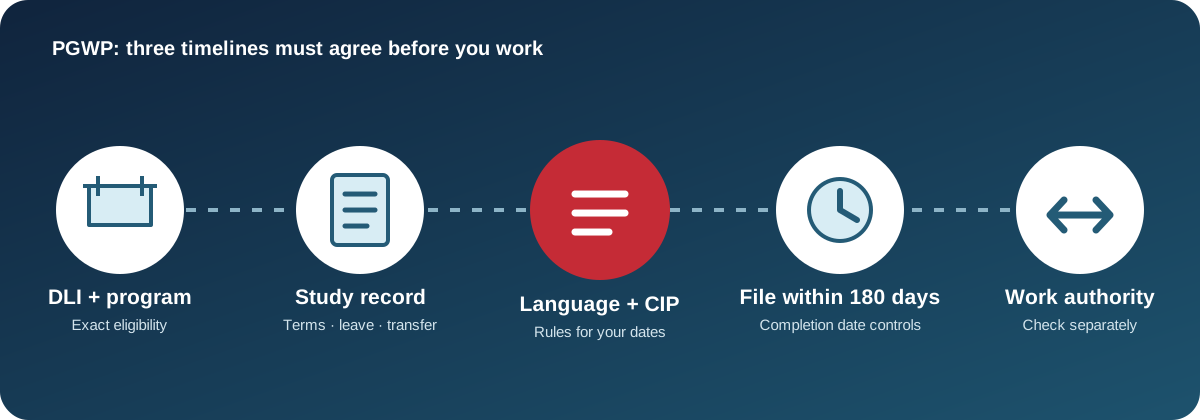
You normally have 180 days after the school first confirms that you completed the program. That deadline does not mean you can always wait six months while remaining in Canada or keep working. Your immigration status and your authority to work must be checked separately.
Who is this for?
This page is for a graduate preparing a first PGWP application, a student choosing a program, or someone whose record includes a transfer, leave or part-time term.
It also helps when a study permit will expire before final marks arrive. A visitor record may protect temporary status, but it does not create permission to work. A person who already received a PGWP normally cannot receive another.
Compare the study-permit page before changing schools. For permanent-residence planning, read the Express Entry page separately; a PGWP can provide authorized work time, but it does not promise a pathway.
What does an immigration officer check?
The officer checks whether you meet the legal requirements and whether the records support the application you submitted.
Did you complete a PGWP-eligible program?
The school must be a designated learning institution and the particular program must be PGWP-eligible.
IRCC generally requires at least eight months of study, or 900 hours for an eligible Quebec credential. Public-private curriculum licensing, language-only and general-interest programs can be ineligible.
Does your study history meet the rule?
IRCC normally expects full-time study in Canada during each academic session, with part-time study allowed in the final session.
Leaves, transfers and online study need their own analysis. For a lock-in date on or after 1 September 2024, at least half the program must generally be completed in class in Canada; time studied abroad is deducted.
Do the language results meet the correct level?
Most applications filed on or after 1 November 2024 require an approved English or French test in all four skills.
University graduates need CLB or NCLC 7. College, polytechnic and other non-university graduates need level 5. IRCC accepts CELPIP-General, IELTS General Training, PTE Core, TEF Canada and TCF Canada.
Does a field-of-study requirement apply?
Degree graduates have no field requirement; many others do when the study-permit application was submitted on or after 1 November 2024.
IRCC uses a six-digit CIP code and transition dates. Flight-school graduates who meet the special PGWP rules are exempt from language and field requirements.
Was the application filed within 180 days?
IRCC measures the period from the school’s first written confirmation that you completed the program.
A completion letter, transcript or credential can establish the date. Your study permit must have been valid during the 180 days. In Canada, a shorter 90-day restoration period may control what remains possible.
Can you work while IRCC processes the application?
Some applicants may work full-time after filing, but only if they met IRCC’s conditions on the submission date.
You needed a valid study permit, completed studies, off-campus eligibility and compliance with the hour limit. Otherwise, wait for the permit. A refusal ends interim work authority when IRCC notifies you.
What evidence makes the application easier to assess?
Good evidence answers a specific concern and agrees with the forms, dates and amounts elsewhere in the file.
School and program eligibility
What it needs to prove: That the institution and exact program qualify and meet the minimum duration.
What leaves questions: A school advertisement or DLI number without the PGWP eligibility entry for the program.
What answers them: The DLI-list entry, admission and completion records, credential and the school’s confirmation of program length.
Completion and study history
What it needs to prove: When the 180-day period began and whether full-time, leave, transfer and distance-study rules were met.
What leaves questions: Only the diploma, with no first-notification date or semester record.
What answers them: Completion letter, final transcript, enrolment history and a dated explanation with records for any interruption or transfer.
Language and field of study
What it needs to prove: That the application meets the level and CIP rule that applies to this credential and study-permit date.
What leaves questions: A school’s program name or an academic English result that IRCC does not accept for PGWP.
What answers them: An approved test report and school evidence identifying the six-digit CIP code, checked against IRCC’s current or applicable transition list.
Status and work authority
What it needs to prove: That the applicant filed from a lawful position and knew whether work could begin or continue.
What leaves questions: Relying on the date printed on a permit after studies ended early.
What answers them: Study permit, submission confirmation, status applications and records showing off-campus eligibility and compliance before graduation.
A composite example
A college graduate receives a completion letter on 12 June. Her study permit remains valid, but she plans to file in October because 180 days have not passed. She has not confirmed the school’s six-digit CIP code and assumes she can work until filing.
She instead asks for the CIP code and transcript, checks the IRCC list, takes an approved language test and files while her permit is valid. Her off-campus eligibility and work-hour record then support the interim work analysis. The 180-day window alone would not protect status or work authority.
What will it cost?
IRCC lists CAD $255 for a PGWP: CAD $155 for the permit and CAD $100 for the open work-permit holder fee. Biometrics can cost CAD $85. We checked these amounts on 8 September 2026.
Restoration adds government fees and does not permit work while waiting. Tests, translations and medical examinations are separate.
A 30-minute consultation is CAD $100.00 total; no HST. We quote review or representation after seeing the program, history, deadlines and status documents.
How long can it take?
The filing deadline is normally 180 days from the school’s first written confirmation of completion. A study permit usually stops being valid 90 days after completion, even if the printed expiry date is later. A person who lost status in Canada may have only 90 days to apply for restoration and cannot work while waiting.
IRCC processing estimates change and start after it receives the application. Medical requests, missing records and a status question can add time. Check the IRCC processing-time tool ↗. Do not promise an employer a start date unless you have confirmed the applicant’s authority to work.

Why can a PGWP application be refused?
A refusal often starts with a question the records did not answer. A new application should address that reason with changed evidence, not simply send the same file again.
The school or exact program is not PGWP-eligible
How to address it: Check the DLI list entry for the program and provide the school and credential records that identify it.
The study history does not meet the full-time or in-Canada rules
How to address it: Build a semester-by-semester record and explain any final part-time term, authorized leave, transfer or online period with dated documents.
The language result is missing, unacceptable or below the required level
How to address it: Use an approved test and meet the required CLB or NCLC level in every skill before filing.
The CIP code is absent or ineligible when the field rule applies
How to address it: Obtain the six-digit code from the school and test it against the list and transition date that apply to the study-permit history.
The application missed the completion or restoration deadline
How to address it: Record the first completion-notification date and status expiry before deciding where and when to file.
The applicant worked without authorization
How to address it: Check the study-period limits and all post-completion work conditions; stop work when authority is uncertain and address the record accurately.
What changed recently?
Rules and intake conditions can change. The application must use the requirements that apply on the day it is submitted.
IRCC changed the eligible fields list
IRCC added 119 fields and removed 178. Transition protection depends on the study-permit application date, so a current search result cannot be read without that date.
Read the IRCC source ↗IRCC froze the field list for the year
IRCC says it will not add or remove eligible fields during 2026. Applicants should still check the six-digit code and the official page before filing.
Read the IRCC source ↗IRCC confirmed the current PGWP fee
IRCC continues to list CAD $155 for the work permit plus the CAD $100 open work-permit holder fee. Biometrics and restoration can add separate charges.
Read the IRCC source ↗
What can you do yourself, and what can we do?
You can prepare and submit your own application. Professional help is useful when you want someone to test the evidence against the rules, identify gaps and put the scope in writing.
Do it yourself
You can check the DLI and program, obtain the CIP code and transcript, take an approved test and file through your IRCC account. Make a timeline of every semester, leave, transfer, online period, completion notice and permit expiry.
Save the CIP result, test report, uploads and submission confirmation. Before working, compare your facts with IRCC’s four conditions and keep the proof for an employer.
Work with our office
Our office can review the program, study history, language result, CIP rule, deadline and status. We compare the application with the source records. Representation begins under a separate written retainer.
We cannot change an ineligible program, extend the filing period or create work authority. If PGWP is unavailable, a consultation can assess another permit category without promising it will succeed.
Where our work stops: We do not promise a PGWP length, tell a person to work without documented authority, change school records or present a future permanent-residence result as a consequence of receiving a PGWP.
Post-graduation work permit questions
Do all graduates of a Canadian DLI qualify for a PGWP?
No. The exact program must be PGWP-eligible, and the applicant must meet the study-history, deadline, language, field-of-study and location rules that apply.
How long do I have to apply after graduation?
You normally have 180 days from the school’s first written confirmation that you completed the program. Status and work authorization have separate, often shorter, timelines.
What language level do I need?
Bachelor’s, master’s, doctoral and other university graduates generally need CLB or NCLC 7 in all four skills. College, polytechnic and other non-university graduates generally need level 5.
Does my program need an eligible CIP code?
Bachelor’s, master’s and doctoral graduates do not have a field requirement. Many other graduates do if their study-permit application was submitted on or after 1 November 2024.
Can I work while IRCC processes my PGWP?
Only if you met IRCC’s conditions when you applied, including a valid study permit, completed studies, off-campus work eligibility and compliance with the hour limit.
How long can a PGWP be valid?
It depends on the program level and length and the passport expiry. A qualifying master’s program of at least eight months can support up to three years; other programs under two years may receive up to their study length.
Can I extend a PGWP?
A PGWP is generally issued once. IRCC allows a paper extension when the first permit was shortened because the passport expired before the full eligible period.
Official sources
The pages we checked when we last reviewed this program.
This article is general information only. It is not legal advice or a legal opinion, and it does not create a consultant-client relationship.