

How we review it
Your documents come first
Here is what we look at, in order.
- 01
Strategy assessment
Review the applicant, business, corporate relationships, proposed Canadian activity and short- and long-term objectives.
- 02
Category and evidence plan
Identify the specific exemption category, required employer steps and the evidence needed to support the role and claimed Canadian benefit.
- 03
Application preparation
Prepare consistent forms, corporate evidence, business documentation and submissions without overstating projected outcomes.
- 04
Post-decision planning
If approved, track permit conditions and reassess any future extension or permanent-residence strategy under current rules.
In plain terms
What is a business immigration or work-permit strategy?
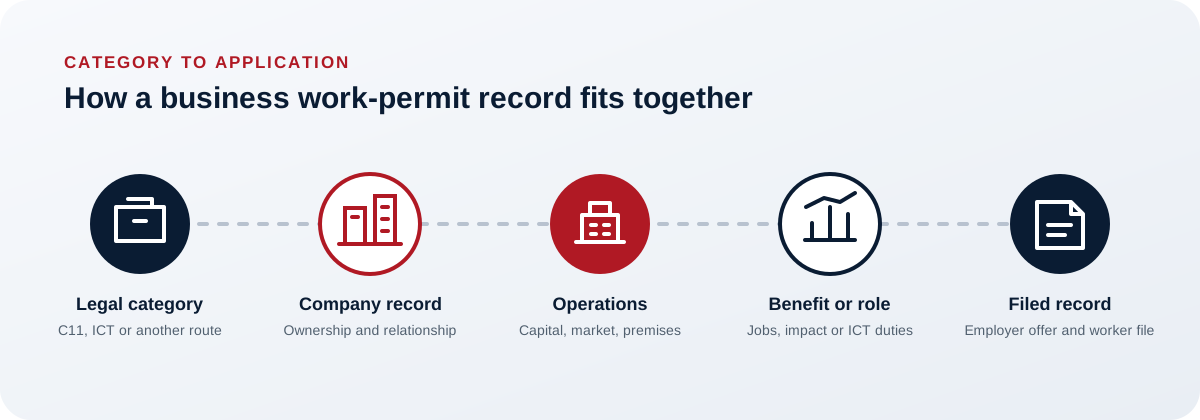
This page covers several temporary work-permit routes connected to a business. It is not one program with one checklist. An entrepreneur may ask IRCC for an LMIA-exempt employer-specific work permit where the proposed activity would create or maintain a significant benefit in Canada. An established foreign company may transfer an eligible executive, manager or specialized-knowledge worker to a related Canadian operation. Another case may require an LMIA or a provincial business pathway instead.
The legal category comes first because it controls the employer steps and the evidence. Owning shares, incorporating a company or buying a business does not by itself authorize you to work in Canada. A temporary work permit also does not promise permanent residence. We assess the immediate work-permit question and any longer-term plan separately, using the rules in force when each application is made.
Who is this for?
This page is for a business owner who plans to open or operate a Canadian company, an established company moving a senior or specialized employee into Canada, or a person deciding whether a proposed acquisition supports any immigration route. It is also useful when a business plan was prepared before anyone identified the immigration category it needs to prove.
A passive investment is different from proposed work. A person who buys property or shares and has no qualifying role cannot rely on ownership alone. A new Canadian company also needs more than projections: the records should explain who controls it, where the money came from, what will happen during the requested work period and why this applicant is needed.
If your main objective is permanent residence, compare the temporary strategy with our Express Entry page and the current provincial options before committing capital. The federal Start-Up Visa and Self-Employed Persons Program pages show their separate intake status.
What does an immigration officer check?
The officer checks whether you meet the legal requirements and whether the records support the application you submitted.
Which legal category applies?
The application needs a specific LMIA exemption or another work-permit basis; a marketing label such as “owner-operator visa” is not a legal category.
IRCC assesses the exemption named in the employer offer and worker application. For an entrepreneur or self-employed person, the significant-benefit analysis is often associated with exemption code C11. An intra-company transfer has different corporate and role tests. If the facts do not fit an exemption, an LMIA or another route may need to be considered.
Is the Canadian activity genuine and ready to operate?
The records should show what the business will do, who will pay for it and what the applicant will actually do in Canada.
An incorporation certificate proves that a corporation exists. It does not prove a market, available capital, premises, suppliers, customers or an operating timetable. The evidence should match the stage of the business. A new operation may rely on signed financing, lease negotiations and contracts; an operating company should normally have records of its activity.
What Canadian benefit is supported?
A C11 record should connect the proposed work to a significant economic, social or cultural benefit, or to maintaining work or opportunities in Canada.
The benefit cannot rest on a slogan. The officer needs facts that can be checked: the applicant’s control and experience, the amount committed, the stage of implementation, plausible Canadian hiring or supplier activity and the effect during the requested period. A forecast is stronger when assumptions come from contracts, market records and an operating budget.
Does an intra-company transfer meet its own tests?
The foreign and Canadian organizations need a qualifying relationship, and the proposed worker must fit an eligible executive, managerial or specialized-knowledge role.
Corporate charts are only a starting point. Ownership records, registrations and operating documents should show the relationship. The job description must explain decision authority or the advanced proprietary knowledge and expertise the Canadian operation requires. A senior title with ordinary duties leaves the central question unanswered.
IRCC — Work permits with special instructions (company transfers) ↗
Were the employer steps completed before filing?
For an employer-specific LMIA-exempt work permit, the employer generally submits the offer through the Employer Portal and pays the compliance fee before the worker applies.
The offer number, exemption code, employer name, duties, wage and work location must agree with the worker application and supporting records. IRCC states that it can refuse an application when the employer has not submitted the offer and paid the fee before the work-permit application.
Does the worker meet the temporary-resident and admissibility rules?
The business case does not remove the ordinary work-permit, temporary-resident or admissibility requirements.
The forms and evidence should address immigration history, intended work, family circumstances and any medical, criminal or security issue that applies. A future permanent-residence objective can exist, but the applicant still has to comply with the conditions of the temporary stay and leave when authorized status ends unless another status is obtained.
What evidence makes the application easier to assess?
Good evidence answers a specific concern and agrees with the forms, dates and amounts elsewhere in the file.
Ownership and corporate relationship
What it needs to prove: Who controls the Canadian and foreign entities and, for an ICT, how they are related.
What leaves questions: A diagram made for the application with no underlying share or registry records.
What answers them: Corporate registries, share ledgers, organizational records, tax or operating documents and an explanation that reconciles names and percentages.
Capital and source of funds
What it needs to prove: That the business has usable money and that the applicant can explain its lawful source.
What leaves questions: A recent balance or transfer with no transaction history, sale record or income trail.
What answers them: Bank history, sale or dividend records, loan terms, company accounts and a Canadian budget that reconciles the committed amount.
Market and operating plan
What it needs to prove: How the company will start or continue real activity during the requested permit period.
What leaves questions: A generic business plan that could describe any city, customer or owner.
What answers them: Supplier and customer discussions, premises records, licences, pricing, competitor research, hiring stages and assumptions tied to the financial model.
Applicant role and experience
What it needs to prove: Why this person is qualified and needed for the proposed Canadian duties.
What leaves questions: A senior title, copied job description or résumé that does not match the proposed work.
What answers them: Employment history, reporting authority, work samples where appropriate, decision records and duties that agree across the portal offer, forms and business evidence.
A composite example
An established industrial-parts manufacturer outside Canada decides to open an Ontario sales and service subsidiary. It proposes to transfer its operations director for eighteen months. The difficult question is not whether the foreign company is successful. The file has to show the relationship between the two companies, why the Canadian duties are executive or managerial, and what the new operation will do during the requested period.
The record could include the foreign company’s operating and payroll documents, share records for both entities, the director’s reporting authority, the Canadian incorporation and bank records, premises negotiations, supplier correspondence and a staged hiring plan. The figures should agree with the money actually available. If the proposed duties are mainly sales calls and routine administration, an executive title will not repair that gap. The category and the evidence may need to change.
What will it cost?
The IRCC work-permit fee is CAD $155. Biometrics cost CAD $85 for one person when required, with a CAD $170 maximum for an eligible family applying together. For an employer-specific LMIA-exempt offer, the employer compliance fee is normally CAD $230. We checked these government charges on 8 September 2026.
Separate expenses can include translations, medical exams, police certificates, corporate searches, accounting records, market research and professional work on the business plan. Incorporation, leases, deposits and operating capital belong to the business budget; paying them does not buy an immigration result.
A 30-minute consultation is CAD $100.00 total; no HST. We quote review-only work or full representation in writing after we see the category, corporate records and proposed scope. That quote identifies what is included. Government and third-party refund decisions follow their own terms.
How long can it take?
There is no single processing time for every business work permit. IRCC’s estimate depends on the application type and the place from which the worker applies. The employer must complete the required portal offer first in an employer-specific LMIA-exempt case. The worker then submits the application with the offer number and supporting record.
Corporate restructuring, missing ownership records, medical or security checks and a request for further documents can add time. A lease start, purchase closing or payroll date should not be built around a promised immigration decision. Check the IRCC processing-time tool ↗ when planning, and keep a separate contingency plan for the business.

Why can a business work-permit application be refused?
A refusal often starts with a question the records did not answer. A new application should address that reason with changed evidence, not simply send the same file again.
The legal category is not established
How to address it: Identify the regulation or exemption code and show how every material fact meets that route.
The claimed Canadian benefit is speculative
How to address it: Tie jobs, spending or another claimed benefit to available capital, contracts, market records and a dated implementation plan.
The source or availability of money is unclear
How to address it: Trace the funds from their source into accounts the business can use and reconcile them with the operating budget.
The corporate relationship or proposed role is unsupported
How to address it: Use underlying ownership and operating records, then match the worker’s authority or specialized knowledge to the actual Canadian duties.
The portal offer and worker file do not agree
How to address it: Check the employer name, exemption code, duties, wage, location and dates across every submission before the worker applies.
The temporary-resident record leaves an unanswered concern
How to address it: Address immigration history, intended stay, family circumstances and admissibility with the applicant’s real records.
What changed recently?
Rules and intake conditions can change. The application must use the requirements that apply on the day it is submitted.
IRCC removed job-offer points from Express Entry CRS scores
A qualifying offer can still matter to eligibility in some Express Entry programs, but it no longer adds 50 or 200 CRS points. A temporary business work permit and a permanent-residence strategy must therefore be assessed separately.
Read the IRCC source ↗Current work-permit and employer fees were checked
IRCC continues to list CAD $155 for a work permit and CAD $230 for the employer compliance fee. This is a source check, not an announcement that C11 or ICT applications are automatically available or approved.
Read the IRCC source ↗
What can you do yourself, and what can we do?
You can prepare and submit your own application. Professional help is useful when you want someone to test the evidence against the rules, identify gaps and put the scope in writing.
Do it yourself
You can identify the proposed activity, read the IRCC instructions, gather corporate and personal records, prepare the portal offer where required and submit your own application. Start by writing a one-page chronology of the companies, ownership changes, investment and proposed Canadian work. Then compare each claim in the business plan with a source record.
Keep a copy of the employer submission, fee receipt, offer number, forms and uploaded evidence. Check names, dates, wages and duties across the entire file. If the facts fit no exemption, do not force them into C11 or ICT terminology.
Work with our office
Our office can compare the proposed facts with the available work-permit categories, identify employer obligations, review the corporate relationship, test the source-of-funds record and examine whether the claimed benefit or role is supported. We can also compare the temporary plan with a separate permanent-residence objective without presenting one as a guaranteed result of the other.
A consultation covers advice about the documents and facts you provide. Review-only work or representation begins under a separate written agreement that names the responsible licensee, tasks and fee. Business, tax, securities, employment and corporate-law questions may require an accountant or lawyer working within that professional’s own scope.
Where our work stops: We do not create transactions to make a company look active, invent customers or jobs, certify financial projections, give tax or corporate-law advice, or promise a work permit or permanent residence.
Business work-permit questions
Does buying or opening a Canadian business guarantee a work permit?
No. Ownership or incorporation does not authorize work. The applicant and proposed activity must meet a specific work-permit category, and IRCC decides the application.
What is a C11 work permit?
C11 is an LMIA-exemption code commonly associated with entrepreneurs or self-employed people whose proposed work would create or maintain a significant benefit in Canada. The evidence and employer steps depend on the actual facts.
Is an LMIA always required for a business owner?
No. Some applicants may fit an exemption under the International Mobility Program. Others may need an LMIA or may have no suitable work-permit route. The category has to be established before filing.
Who can qualify as an intra-company transferee?
The case needs qualifying foreign and Canadian organizations plus a worker and role that meet the applicable executive, managerial or specialized-knowledge requirements. A matching job title alone is insufficient.
Does the Canadian company need to be operating already?
The answer depends on the category and the company’s stage. A new operation can be considered, but it needs credible establishment records, available capital and a plan that explains what will happen during the requested period.
Can a C11 or ICT work permit lead to permanent residence?
It can form part of a longer plan for some people, but it does not guarantee permanent residence. Eligibility and selection must be checked under the separate rules in force when the person applies.
What should I bring to a business immigration consultation?
Bring the ownership chart and registry records, a short business history, the proposed Canadian activity, available-funds evidence, the applicant’s résumé and any existing business plan, purchase agreement or refusal letter.
Official sources
The pages we checked when we last reviewed this program.
This article is general information only. It is not legal advice or a legal opinion, and it does not create a consultant-client relationship.