

How we review it
Your documents come first
Here is what we look at, in order.
- 01
Profile and goal review
Clarify academic background, work experience, language level, career plan, budget and preferred location.
- 02
School and program comparison
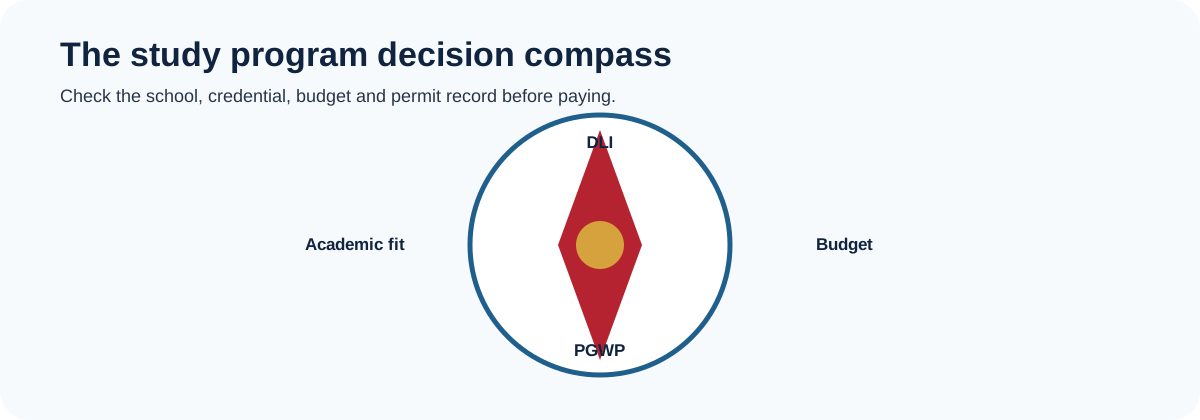
Compare verified programs, admission requirements, tuition, refund terms, DLI status and current PGWP implications.
- 03
Admission decision
Review the offer and material conditions before deposits or other non-refundable commitments.
- 04
Study-permit preparation
Move to the separate immigration application only after the admission and financial plan are supportable.
In plain terms
How should you choose a Canadian program?
Choosing a school is an education, cost and immigration decision made before the study-permit application. A designated learning institution can host international students, but not every program at every DLI is eligible for a post-graduation work permit. The program should also make sense after your earlier education and work.
We compare the credential, campus, curriculum, tuition, living budget, DLI status, PGWP details and the study-permit evidence. The best choice is one you would still defend if immigration rules changed. Admission alone does not guarantee a study permit, work after graduation or permanent residence.
Who is this for?
You are comparing two Canadian colleges with different PGWP entries. You already hold a degree and need to explain why a shorter credential advances your work. You are choosing between a public master’s program and a private diploma with different PAL and work implications.
This page is for planning before a deposit. Once you have admission, use the study-permit requirements page. If work after graduation matters, verify the exact program on the PGWP page.
What does an immigration officer check?
The officer checks whether you meet the legal requirements and whether the records support the application you submitted.
Is the school a designated learning institution?
A post-secondary applicant needs a letter of acceptance from a DLI.
IRCC’s list identifies the institution, DLI number, campus and whether it offers PGWP-eligible programs. A marketing page or agent statement is not the official entry.
Is the exact program PGWP-eligible?
DLI status does not make every program eligible for a PGWP.
Check the school’s expanded entry and the PGWP rules for credential level, program length, public-private licensing and field of study. Save the result on the date you decide.
Does the program fit your history?
The study plan should explain why this curriculum is a sensible next step for you.
Compare course content with earlier education and work. A lower credential, career change or repeated subject can still have a reason, but the evidence must show it.
Can you fund the first year and the full plan?
Tuition, living costs and travel need a credible source and a plan beyond the first bank statement.
For applications outside Quebec on or after 1 September 2026, IRCC lists CAD $23,448 for one person’s first-year living expenses, excluding tuition and transportation. Family size changes the amount.
Will a PAL or TAL be required?
Most applicants need a provincial or territorial attestation letter unless an exemption applies.
From 1 January 2026, master’s and doctoral students at public DLIs are among the exempt groups. Quebec also has its own provincial requirements.
What evidence makes the application easier to assess?
Good evidence answers a specific concern and agrees with the forms, dates and amounts elsewhere in the file.
School and program record
What it needs to prove: The institution, campus, credential and immigration characteristics chosen.
What leaves questions: A recruiter brochure describing the school as “PGWP approved.”
What answers them: DLI-list entry, official program page, curriculum, length and written school confirmation of the exact credential.
Academic progression
What it needs to prove: Why the program adds something the applicant does not already have.
What leaves questions: A statement that Canadian education is better.
What answers them: Transcripts, work records and course comparisons linked to a specific next step.
Budget and source of funds
What it needs to prove: That the student can pay tuition, living costs and travel.
What leaves questions: A recent balance with no source or plan for year two.
What answers them: Tuition invoice, account history, income and sponsor records plus a full-program budget.
Decision and refund record
What it needs to prove: What the student understood before paying a deposit.
What leaves questions: Verbal promises from a recruiter.
What answers them: Offer, refund policy, deadlines, housing assumptions and saved official eligibility checks.
A composite example
A software tester with a bachelor’s degree compares a one-year private-college diploma and a public two-year program. The private option is cheaper and advertises faster admission, but its DLI entry does not show the program as PGWP-eligible.
The student checks both entries, compares the curricula with current work and builds a two-year budget. The public program adds automation subjects missing from earlier study and has written PGWP information. That does not guarantee a permit or PGWP; it gives the student a decision based on the official record rather than a sales promise.
What will it cost?
School costs vary by program. For the immigration stage, IRCC lists a CAD $150 study-permit fee and biometrics of CAD $85 per person. Applicants must also budget for tuition, deposits, living costs, travel, medical exams, translations and sometimes tests. School refund rules decide whether a deposit is recoverable.
We quote school/program risk review or study-permit work after seeing the shortlist and history. See our fees and cost guide.
How long can it take?
Admission, PAL/TAL and study-permit processing have separate timelines. You control early document requests, school deadlines and a complete permit record. Schools and governments control admissions, allocations and decisions.
Use the IRCC processing-time tool ↗ and avoid non-refundable travel until the immigration decision is known.

Why can a study plan fail before or during the permit application?
A refusal often starts with a question the records did not answer. A new application should address that reason with changed evidence, not simply send the same file again.
The exact program is not PGWP-eligible
How to address it: Check the DLI entry and program details before paying a deposit.
The credential repeats earlier education without explanation
How to address it: Compare courses and connect the missing skills to documented work or career plans.
The budget covers only the deposit
How to address it: Plan tuition, living costs and travel for the full program and show the source.
A required PAL or TAL is missing or invalid
How to address it: Confirm the requirement, exemption and validity before filing.
The application relies on a recruiter promise
How to address it: Save the official DLI, IRCC and school records that support each decision.
What changed recently?
Rules and intake conditions can change. The application must use the requirements that apply on the day it is submitted.
Public master’s and doctoral programs gained a PAL/TAL exemption
IRCC exempts students in qualifying degree programs at public DLIs, while other 2026 applicant groups remain under the cap rules.
Read the IRCC source ↗The outside-Quebec living-expense amount increased
IRCC lists CAD $23,448 for one applicant’s first year, excluding tuition and transportation.
Read the IRCC source ↗
What can you do yourself, and what can we do?
You can prepare and submit your own application. Professional help is useful when you want someone to test the evidence against the rules, identify gaps and put the scope in writing.
Do it yourself
You can build a shortlist, check each DLI entry, compare curricula and calculate a full budget. Save a PDF or screenshot of official entries and the school’s refund policy on the decision date.
Use the preliminary assessment after you have a shortlist, not after paying a non-refundable deposit.
Work with our office
We can compare the immigration consequences of the shortlist, test academic progression, review the funds plan and identify PAL, PGWP or permit risks. Under a separate retainer, we prepare the study-permit application.
We do not choose a school because it pays a referral fee or promise that a credential will lead to permanent residence.
Where our work stops: We cannot guarantee admission, a study permit, PGWP eligibility at graduation or a later immigration pathway, and we do not replace academic or financial advice.
Choosing a Canadian program questions
Does every DLI offer PGWP-eligible programs?
No. Check the exact program under the institution’s DLI entry and then test the other PGWP requirements.
Is a public school always safer?
Public status can matter to some rules, but the exact campus, credential, program and applicant history still require review.
Should I choose a one-year or two-year program?
Compare education value, cost, immigration rules and how the program fits your history. A longer program costs more and does not guarantee a longer permit.
Do I need a PAL or TAL?
Most study-permit applicants do unless an exemption applies. Public master’s and doctoral students are among the exempt groups from 1 January 2026.
How much money should I budget?
Use tuition, travel and IRCC’s current living-expense amount for your family size, then plan for the full program rather than year one alone.
Can a recruiter guarantee a PGWP?
No. IRCC decides eligibility under the rules that apply, and not every program at a DLI qualifies.
Official sources
The pages we checked when we last reviewed this program.