

How we review it
Your documents come first
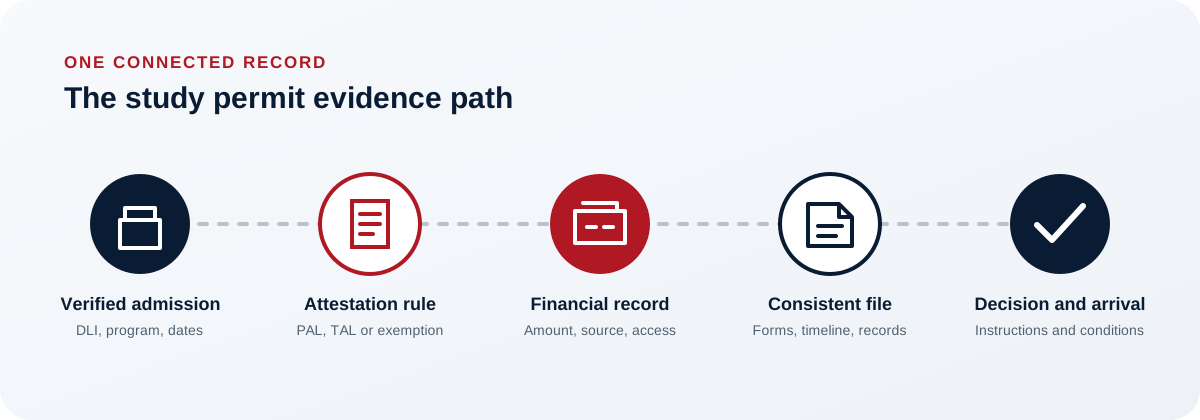
Here is what we look at, in order.
- 01
Admission and DLI review
Verify the school, program, intake dates, tuition, refund terms and post-graduation work-permit implications before paying non-refundable amounts.
- 02
PAL or TAL and financial plan
Confirm whether an attestation letter is required and build evidence for tuition, living expenses and transportation.
- 03
Application preparation
Prepare forms and a consistent document record addressing study purpose, education, work, family, finances and travel history.
- 04
Decision and arrival planning
Follow IRCC instructions, avoid irreversible travel decisions before approval and understand the conditions that apply after arrival.
In plain terms
What is a Canadian study permit?
A study permit is the document that lets a foreign national study at a designated learning institution in Canada. It is temporary status. It is not an entry visa, permanent residence or a promise that another immigration program will be available after graduation.
An admission letter starts the process. IRCC still expects the right provincial or territorial attestation letter when one is required, evidence that the money is available, a study purpose that fits your history, complete forms and proof that you will respect the conditions of temporary residence. The 2026 cap also means that timing and the validity of an attestation letter matter.
Who is this for?
This page is for you if a Canadian school has offered you admission and you now need to prepare the immigration application. It also helps if you are comparing schools before paying a deposit, supporting a spouse or child who will accompany you, or deciding whether a refused application can be rebuilt with better evidence.
A person with five years of work experience may have a sensible reason to take a Canadian diploma, but the officer cannot assume what that reason is. The application must show how the program connects to the person’s education, work and plans after study. If you are still choosing a school, start with our study-in-Canada planning page. If work after graduation matters to your decision, read the current post-graduation work permit page before paying a non-refundable amount.
What does an immigration officer check?
The officer checks whether you meet the legal requirements and whether the records support the application you submitted.
Is the admission valid?
You need a valid letter of acceptance from a designated learning institution.
IRCC asks the school to validate the letter. The name, program, start date and campus should agree with the information in the application. A school admission decision does not decide the study-permit application.
Do you need a PAL or TAL?
Most applicants need a current provincial or territorial attestation letter, but IRCC lists exemptions.
The school normally explains how to obtain the letter. A letter issued for an earlier cap year cannot be reused for a 2026 application. Public-DLI master’s and doctoral degree students have been exempt since 1 January 2026; other exemptions depend on the applicant and the application type.
Is the money enough and available?
IRCC looks at the amount, its source and whether you can actually use it.
For an application outside Quebec submitted on or after 1 September 2026, one applicant must show CAD $23,448 for first-year living expenses, in addition to tuition and transportation. A longer program also needs a plan for the full duration. IRCC lists six months of bank statements and evidence of the source of income among the records it may use.
Does the study plan fit your history?
The program choice should make sense when the officer compares it with your education, work and stated plans.
A study plan should explain the decision in the applicant’s own facts. It should not hide a gap, change a job title or make a Canadian credential sound necessary when the records show otherwise. The point is to make the evidence understandable, not to write a dramatic story.
Will you respect temporary status?
You must satisfy the officer that you will leave Canada when the study permit expires.
The officer can consider travel and immigration history, family circumstances, employment, finances and the reason for study. Medical, criminality or security checks may also apply. A wish to qualify for permanent residence later does not remove the temporary-resident requirements that apply now.
What evidence makes the application easier to assess?
Good evidence answers a specific concern and agrees with the forms, dates and amounts elsewhere in the file.
Academic and program logic
What it needs to prove: Why this program is a sensible next step for this applicant.
What leaves questions: A generic statement about Canada, rankings or better opportunities.
What answers them: Transcripts, employment records and a plain explanation connecting the curriculum to a specific next step.
Source and availability of money
What it needs to prove: That the required funds exist, have a credible source and can be used for study.
What leaves questions: A recent large deposit with no record of where it came from.
What answers them: Six months of statements, income or business records, sponsor evidence where relevant and a budget that reconciles with tuition.
Personal and family circumstances
What it needs to prove: How the study period fits with obligations, plans and the applicant’s temporary stay.
What leaves questions: A list of property or relatives with no explanation of why it matters.
What answers them: Specific records that agree with the proposed timeline, family plan and employment or business circumstances.
Application consistency
What it needs to prove: That the officer can follow the same facts across every form and document.
What leaves questions: Different dates, untranslated records or unexplained gaps.
What answers them: A checked chronology, certified translations where required and a short note for any genuine discrepancy.
A composite example
An accountant with a bachelor’s degree and five years of work experience is admitted to a one-year data-analytics program. The file will raise a reasonable question: why take a shorter diploma after a degree? Repeating that Canadian education is excellent does not answer it.
A better record identifies the analytical work the applicant already performs, the subjects in the Canadian curriculum that are missing from earlier study, what the employer or business expects after the person returns, and how the tuition and living costs will be paid. Employment letters, course descriptions and financial records should support that explanation. This can make the decision easier to assess; it cannot guarantee approval.
What will it cost?
The IRCC study-permit fee is CAD $150. Biometrics are CAD $85 for one person when required; IRCC lists a family maximum of CAD $170 for eligible family applications submitted together. We checked these government charges on 8 September 2026. Medical exams, police certificates, translations, courier or visa-application-centre services and school deposits are separate.
A 30-minute consultation is CAD $100.00 total; no HST. Review-only work and full representation are quoted in writing after the consultation, once we know the records and the work required. The written scope lets you compare what is included before you decide.
How long can it take?
IRCC publishes a current estimate by application type and country. It is not a deadline or a maximum. Processing starts when IRCC receives a complete application and ends when it makes a decision; biometrics are included in the estimate.
Missing records, verification work, medical or security checks and the time you take to answer a request can extend the file. School start dates, PAL or TAL validity and refund deadlines need their own calendar. Check the IRCC processing-time tool ↗ on the day you plan.

Why can a study-permit application be refused?
A refusal often starts with a question the records did not answer. A new application should address that reason with changed evidence, not simply send the same file again.
The program choice is not explained
How to address it: Connect the curriculum to the applicant’s actual education and work, and support the connection with records.
The financial record leaves a gap
How to address it: Trace large deposits, document the source of support and show a budget for tuition, living costs and transportation.
The PAL or TAL is missing or unusable
How to address it: Confirm whether one is required and submit a valid letter for the current cap year, or evidence of the exemption.
Forms and documents do not agree
How to address it: Build one chronology and reconcile employment, study, travel, addresses and family information before filing.
Temporary-resident intent is not established
How to address it: Address the officer’s concern with the applicant’s real circumstances and records. Do not invent ties or repeat unsupported statements.
What changed recently?
Rules and intake conditions can change. The application must use the requirements that apply on the day it is submitted.
The living-expense amount increased
For applications outside Quebec submitted on or after this date, one applicant must show CAD $23,448 for living expenses, plus tuition and transportation.
Read the IRCC source ↗Some graduate students became exempt from a PAL or TAL
Students in master’s and doctoral degree programs at public designated learning institutions no longer need an attestation letter. Other applicants must check the exemption list.
Read the IRCC source ↗An older attestation letter cannot be reused
IRCC says a PAL or TAL issued for a previous cap year cannot support a 2026 application. A 2026 letter normally expires by 31 December 2026 unless it shows an earlier date.
Read the IRCC source ↗
What can you do yourself, and what can we do?
You can prepare and submit your own application. Professional help is useful when you want someone to test the evidence against the rules, identify gaps and put the scope in writing.
Do it yourself
You can read the IRCC instructions, open your own online account, collect the documents and submit the application yourself. Start with the official document page ↗ and the visa-office instructions for the place where you apply.
Use one timeline for addresses, education, employment and travel. Check every amount and date against the source record. Keep a copy of the final forms, uploaded files and payment receipt.
Work with our office
Progressive Immigration Services Inc. has operated since 2005, with its licensed practice running since April 2012. For a study-permit matter, we can identify the legal tests, review the admission and attestation records, test the financial history, compare the forms with the evidence and explain weaknesses before filing.
A consultation gives advice about the facts you bring. Review-only or full representation begins under a separate written agreement that identifies the responsible licensee, the work included and the fee. If a refusal needs a different professional or a Federal Court remedy, we say so.
Where our work stops: We do not choose a school for you, invent a study purpose, move money to make a balance look stronger or promise that an officer will approve the application.
Study permit questions
Is a letter of acceptance enough for a study permit?
No. It proves admission, but the application must also address the PAL or TAL rule where it applies, finances, study purpose, temporary-resident requirements and admissibility.
Does every applicant need a PAL or TAL?
No. Most applicants need one, but IRCC lists exemptions. The answer depends on the applicant, the type of study and the application being submitted.
How much money does one applicant need?
For an application outside Quebec submitted on or after 1 September 2026, IRCC requires CAD $23,448 for first-year living expenses, plus tuition and transportation. A larger family needs the current family amount. Quebec has separate rules.
Can I rely on work in Canada to cover the required funds?
No. IRCC requires you to show that you can pay tuition, living expenses and transportation without working in Canada. Work authorization after arrival does not replace that evidence.
Does a study permit lead directly to permanent residence?
No. A study permit is temporary status. A later work permit or permanent-residence application has its own rules, and those rules can change before you graduate.
Can a consultant guarantee approval?
No. A licensed consultant can assess the rules, explain risk and prepare work covered by a written agreement. IRCC makes the decision.
What should I do after a refusal?
Read the refusal reasons and compare them with the application that was filed. Reapply only when you can answer the concern with changed or clearer evidence. A new PAL or TAL may be required after a refusal.
Official sources
The pages we checked when we last reviewed this program.
This article is general information only. It is not legal advice or a legal opinion, and it does not create a consultant-client relationship.