

How we review it
Your documents come first
Here is what we look at, in order.
- 01
Purpose and history review
Review the reason for travel, dates, invitation, prior refusals, travel history and family circumstances.
- 02
Financial and supporting evidence
Document how the trip will be funded and ensure the applicant and host evidence is consistent.
- 03
Application preparation
Prepare accurate forms and submissions that address the applicant’s circumstances without generic promises.
- 04
Decision and entry
Understand that a visa permits travel to a port of entry; the border officer decides admission and the authorized period.
In plain terms
What is the difference between a visitor visa and a Super Visa?
A visitor visa is the document many travellers need before they can travel to Canada. It can be issued for one or more entries, but a visa does not guarantee entry or decide how long you may stay. A border officer makes that decision. The Super Visa is for eligible parents and grandparents who want longer visits with a Canadian or permanent-resident child or grandchild. It can support stays of up to five years at a time and adds income, insurance and medical requirements.
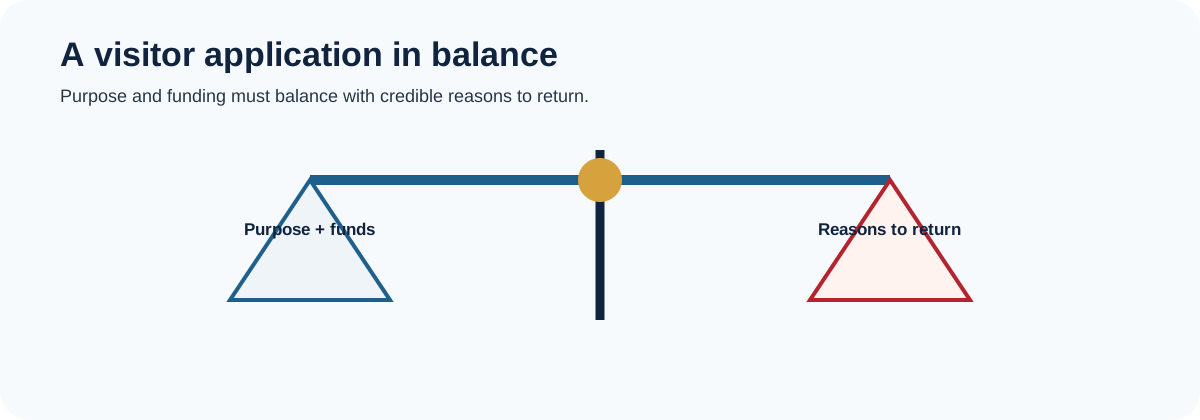
Both applications turn on temporary intent. IRCC asks why you are coming, how the visit will be paid for and why you will leave when the authorized stay ends.
Who is this for?
You want to visit family for a wedding and can document the dates, host and costs. You plan a short business visit and need records that separate meetings from work in Canada. You are a parent or grandparent who wants a longer stay and can meet the Super Visa rules.
A visitor visa does not authorize employment or regular study. If that is the purpose, compare the work-permit options or study-permit requirements. A parent seeking permanent residence should read the family sponsorship page, noting that new PGP intake is paused.
What does an immigration officer check?
The officer checks whether you meet the legal requirements and whether the records support the application you submitted.
Is the purpose of the visit specific and credible?
The officer compares the stated reason, dates and activities with the invitation and available records.
A two-week family visit is easier to understand when the host, accommodation and return date agree. “Tourism for several months” with no itinerary or budget leaves basic questions unanswered.
Will the visitor leave Canada?
IRCC must be satisfied that the person will leave at the end of the authorized stay.
Employment, business, studies, property, close family obligations and travel history can support that conclusion. The application should also address factors that point toward remaining in Canada instead of ignoring them.
Can the visit be paid for?
The budget must fit the length and purpose of the trip and show who controls the money.
IRCC does not publish one visitor-visa minimum. Bank balances, regular income, accommodation and host support need to agree with the planned visit.
Does a Super Visa application meet the added rules?
The applicant must be outside Canada and have an eligible host, qualifying income, one year of approved private health insurance and an immigration medical exam.
The host must be the applicant’s child or grandchild, be at least 18 and live in Canada. IRCC now allows two income approaches and insurance from a foreign insurer only when the minister has approved that company.
Is the applicant admissible?
A strong visit plan cannot overcome an unresolved criminal, medical, security or misrepresentation concern.
Prior refusals, overstays and inconsistent answers belong in the review. The application should disclose them and address the reason, rather than hope the officer will not compare earlier files.
What evidence makes the application easier to assess?
Good evidence answers a specific concern and agrees with the forms, dates and amounts elsewhere in the file.
Purpose and itinerary
What it needs to prove: What the person will do and how long it reasonably takes.
What leaves questions: A generic invitation asking IRCC to grant the longest possible visa.
What answers them: Event, accommodation and travel records matched to a short explanation and budget.
Reasons to return
What it needs to prove: Why the visitor is likely to leave after the trip.
What leaves questions: A job letter with no approved leave, pay or return date.
What answers them: Work or business records, family responsibilities, study commitments and assets chosen for this applicant.
Money and host support
What it needs to prove: Who pays and whether the funds are available.
What leaves questions: A large recent deposit with no source or an invitation that promises every expense without income proof.
What answers them: Account history, income records, a visit budget and host documents that explain any transfer.
Super Visa requirements
What it needs to prove: That both the host and applicant meet the special long-stay rules.
What leaves questions: A travel policy with exclusions or less than one year of coverage.
What answers them: Relationship proof, the host’s income calculation, signed invitation, paid qualifying insurance and medical instructions.
A composite example
A retired mother plans to spend five months with her daughter after a new baby arrives. Her first draft says only that she will “help the family,” and the daughter’s invitation promises all costs. The mother’s pension, property and adult son at home do not appear.
The revised record describes a temporary family visit, includes a budget and return plan, and shows the mother’s own income and obligations. If she chooses a Super Visa, the family adds the host-income calculation, relationship records, medical exam and qualifying insurance. The stronger file does not promise entry; it lets the officer see how the visit will work.
What will it cost?
IRCC listed CAD $100 for either a visitor visa or Super Visa on 8 September 2026. Biometrics can add CAD $85 per person or up to CAD $170 for an eligible family. Super Visa applicants also pay for at least one year of qualifying private health insurance and an immigration medical exam; premiums depend on age, coverage and health.
We quote a review or full application after seeing the travel purpose, refusal history and family group. See our fees and cost guide.
How long can it take?
Visitor-visa estimates vary by country and change with inventory. You control whether the forms, translations, invitation and financial record agree, and how quickly you answer a request. IRCC controls screening and the decision.
Check the IRCC processing-time tool ↗ before choosing non-refundable travel. A visa approval still does not guarantee entry on a particular day.
Why can a visitor or Super Visa application be refused?
A refusal often starts with a question the records did not answer. A new application should address that reason with changed evidence, not simply send the same file again.
The purpose is vague or does not fit the proposed stay
How to address it: Use concrete dates, activities, accommodation and a budget that explain the trip.
The officer is not satisfied the applicant will leave
How to address it: Address both the applicant’s reasons to return and any factor that points toward staying.
The funds do not have a credible source
How to address it: Show account history, income and an explanation for transfers or recent deposits.
The host’s invitation conflicts with the applicant’s forms
How to address it: Compare names, relationships, dates, address, employment and who pays before filing.
A Super Visa income, insurance or medical requirement is missing
How to address it: Use IRCC’s current family-size calculation and submit qualifying paid coverage and medical evidence.
A prior refusal or overstay is not addressed
How to address it: Disclose it, obtain the refusal reasons and file changed evidence instead of repeating the old package.
What changed recently?
Rules and intake conditions can change. The application must use the requirements that apply on the day it is submitted.
Super Visa income and insurance rules changed
IRCC introduced two income methods and permits coverage from an approved foreign insurer as well as a Canadian insurer.
Read the IRCC source ↗Some Indonesian and Malaysian citizens became eligible for an eTA
Qualifying travellers may use an eTA for air travel instead of applying for a visitor visa. The conditions and travel mode still need checking.
Read the IRCC source ↗
What can you do yourself, and what can we do?
You can prepare and submit your own application. Professional help is useful when you want someone to test the evidence against the rules, identify gaps and put the scope in writing.
Do it yourself
You can check the travel document, complete the IRCC forms, assemble the visit record and apply through the correct portal. Build a one-page table showing the trip dates, cost, payer and evidence. Save the submission and biometrics records.
Use the preliminary assessment if you need help choosing between a visitor visa, Super Visa or another service.
Work with our office
We compare the purpose, home-country circumstances, funds, host evidence and previous immigration history. For a Super Visa, we check family size, the income method, insurance and medical requirements. Under a retainer, we prepare the forms and submissions and respond to IRCC.
We do not create employment, bank or relationship records. We cannot guarantee a visa’s validity period or what a border officer will authorize on entry.
Where our work stops: We will not advise a visitor to work without authorization, conceal a refusal or book non-refundable travel on the assumption that IRCC will decide by a chosen date.
Visitor visa and Super Visa questions
How much money do I need for a visitor visa?
IRCC does not publish one fixed visitor-visa amount. The funds must fit the length, accommodation and purpose of your trip, with a source the officer can verify.
Does an invitation letter guarantee approval?
No. It helps establish the host and purpose, but IRCC also examines temporary intent, money, travel history and admissibility.
How long can I stay with a Super Visa?
IRCC describes stays of up to five years at a time. A border officer decides the authorized period when you enter.
Can I buy Super Visa insurance after approval?
No. Proof of qualifying private medical insurance for at least one year is part of the application requirements.
Can I work with a visitor visa?
A visitor visa does not authorize work. You need separate authority under the immigration rules before performing work in Canada.
Should I reapply after a refusal?
Reapply only when you understand the reasons and can provide changed evidence or correct an error. Sending the same package usually leaves the same questions.
Official sources
The pages we checked when we last reviewed this program.
This article is general information only. It is not legal advice or a legal opinion, and it does not create a consultant-client relationship.