

How we review it
Your documents come first
Here is what we look at, in order.
- 01
Category and sponsor review
Confirm the relationship category, sponsor eligibility, residence plans, prior undertakings and any status issue.
- 02
Evidence plan
Organize civil records, relationship evidence, communication, cohabitation, financial and family information appropriate to the case.
- 03
Application preparation
Prepare the sponsorship and permanent-residence components consistently and address prior marriages, refusals or other material facts.
- 04
Processing and updates
Track requests, maintain contact details and report material family or status changes during processing.
In plain terms
How does family sponsorship work in Canada?
Family sponsorship lets an eligible Canadian citizen, permanent resident or person registered under the Indian Act sponsor certain relatives for permanent residence. The relationship decides which rules apply. Spouse, partner and dependent-child applications remain available, while IRCC paused new Parents and Grandparents Program intake in July 2026. A Super Visa is a temporary visit option, not a substitute for permanent residence.
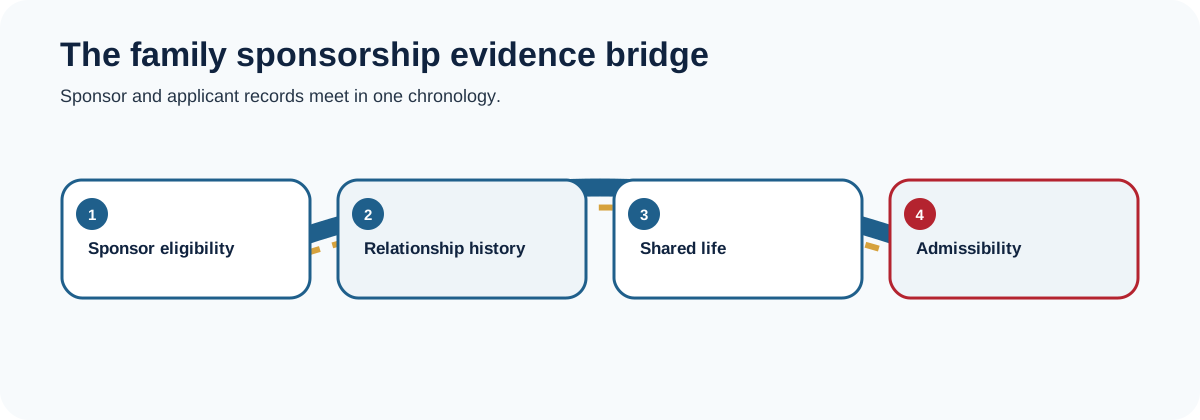
IRCC assesses both sides of the file: whether the sponsor can sign the undertaking and whether the person being sponsored fits the family category and is admissible. A marriage certificate or shared address starts the evidence; it does not finish it.
Who is this for?
You are sponsoring a spouse after living together in Canada, and you need to choose the correct in-Canada or Family Class process. You married abroad after a long-distance relationship and need records that show how the relationship developed. You are sponsoring a dependent child and need the custody, consent and civil-status record to agree.
This page also helps an invited parent-and-grandparent sponsor manage an existing file. New PGP intake is paused. Parents seeking a long visit should compare the Super Visa requirements, while urgent protection issues belong on the refugee-claim page.
What does an immigration officer check?
The officer checks whether you meet the legal requirements and whether the records support the application you submitted.
Can the person legally act as a sponsor?
IRCC checks age, status in Canada, residence and any sponsorship bar.
A sponsor must normally be at least 18. A permanent resident generally needs to live in Canada; a Canadian citizen abroad must show a plan to return. Defaults on earlier undertakings, certain convictions, social assistance and an undischarged bankruptcy can prevent sponsorship.
Does the relationship fit the category?
The forms and evidence must establish the claimed spouse, partner, child or other qualifying relationship.
A common-law partnership normally requires 12 continuous months of cohabitation. Dependent children are usually under 22 and without a spouse or partner, subject to the disability exception. Conjugal-partner cases have their own demanding test.
Is the relationship genuine?
For a spouse or partner, IRCC looks at whether the relationship is genuine and was entered into for reasons beyond immigration status.
Officers compare the couple’s chronology, contact, visits, financial life, family knowledge and explanations for time apart. Different cultures and living arrangements can be genuine, but the record must explain them in the couple’s own facts.
Did everyone disclose the full family history?
IRCC expects previous marriages, children and non-accompanying family members to be declared and examined where required.
A missing child, divorce or prior sponsorship can change eligibility. Civil records, forms and earlier visa applications should use the same names, dates and relationships.
Can the sponsor carry the undertaking?
The sponsor signs a financial undertaking that continues after the person becomes a permanent resident.
Outside Quebec, the undertaking is generally 3 years for a spouse or partner, 10 years or until age 25 for a dependent child under 22, and 20 years for a parent or grandparent. Divorce or unemployment does not cancel it.
What evidence makes the application easier to assess?
Good evidence answers a specific concern and agrees with the forms, dates and amounts elsewhere in the file.
Relationship history
What it needs to prove: How the couple met, committed and built a life together.
What leaves questions: A wedding album with no chronology or evidence between major events.
What answers them: A dated selection of messages, travel, joint decisions and family records tied to a plain timeline.
Shared life
What it needs to prove: Whether the relationship continues beyond the ceremony or application.
What leaves questions: A recently opened joint account that has never been used.
What answers them: Housing, expenses, insurance, beneficiaries, correspondence and explanations that fit the couple’s actual arrangement.
Identity and family composition
What it needs to prove: Who is related to whom and who must be declared or examined.
What leaves questions: Translated certificates with inconsistent spellings and no explanation.
What answers them: Passports, birth and marriage records, divorce or custody documents, certified translations and a name-variation note.
Sponsor eligibility
What it needs to prove: That the sponsor can sign and remain bound by the undertaking.
What leaves questions: A status card without addressing a prior undertaking or residence outside Canada.
What answers them: Status and residence records plus documents resolving any prior sponsorship, support-payment or return-to-Canada issue.
A composite example
A couple married after three years of living in different countries. They had frequent calls but few joint bills. Their first file grouped hundreds of screenshots by app and month, leaving the officer to work out the story.
They rebuilt the record around ten dated events: first meeting, family introductions, visits, engagement, wedding and plans for housing in Canada. Each event used a small number of records and a short explanation. The application did not try to make a long-distance relationship look like cohabitation; it showed how this particular relationship worked.
What will it cost?
On 8 September 2026, IRCC listed CAD $1,260 to sponsor a spouse or partner, including the right of permanent residence fee, and CAD $180 to sponsor a dependent child. Biometrics can add CAD $85 per person or up to CAD $170 for an eligible family. Medical exams, police certificates, translations and document replacement are separate.
We quote review or representation after identifying the family category, number of applicants and evidence issues. See our fees and cost guide.
How long can it take?
IRCC publishes a changing estimate by application type and location. A complete civil record, accurate translations and prompt replies are within your control. Inventory, background checks, medical follow-up and an interview are not.
Use the IRCC processing-time tool ↗. Keep temporary status and work authorization separate from the permanent-residence timeline.

Why can a family sponsorship application be refused?
A refusal often starts with a question the records did not answer. A new application should address that reason with changed evidence, not simply send the same file again.
The sponsor is ineligible or subject to a bar
How to address it: Identify the bar before filing and provide the decision or payment record that resolves it, if it can be resolved.
The relationship category is wrong
How to address it: Match the dates and living arrangement to the legal definition instead of choosing the category by convenience.
The officer is not satisfied the relationship is genuine
How to address it: Answer the concerns with a chronology and representative evidence from the life the couple actually shares.
A family member or prior relationship was omitted
How to address it: Disclose the full history, correct earlier inconsistencies and explain them with records.
The applicant is inadmissible
How to address it: Review criminal, medical, security and misrepresentation issues before relying on relationship evidence.
What changed recently?
Rules and intake conditions can change. The application must use the requirements that apply on the day it is submitted.
IRCC paused new parent and grandparent intake
IRCC will keep processing existing PGP files but will not accept new interest forms or issue invitations until further notice.
Read the IRCC source ↗Permanent-residence fees increased
The family sponsorship fee became CAD $90, the principal applicant processing fee CAD $570 and the right of permanent residence fee CAD $600.
Read the IRCC source ↗
What can you do yourself, and what can we do?
You can prepare and submit your own application. Professional help is useful when you want someone to test the evidence against the rules, identify gaps and put the scope in writing.
Do it yourself
You can select the correct IRCC package, order civil records, build the relationship chronology and submit the application yourself. Save every form, upload and payment receipt. Keep IRCC updated about addresses, births, marriages and other material changes.
The preliminary assessment can help identify the service that fits before you disclose detailed personal history.
Work with our office
We test sponsor eligibility, the relationship category, family composition and the evidence against the forms. We flag contradictions, prepare submissions where the record needs an explanation and manage IRCC correspondence under a written retainer.
We do not manufacture relationship evidence or tell a couple to stage a shared life. A representative changes how the record is prepared and answered; the officer makes the decision.
Where our work stops: We will not hide a prior marriage, child, refusal or sponsorship problem, and we cannot promise that IRCC will waive an interview or approve the relationship.
Family sponsorship questions
Should we apply inland or through the Family Class?
The answer depends on where the applicant lives, travel needs, status in Canada and the evidence. We compare the current IRCC options before choosing the package.
Do we need a joint bank account?
No single document proves a genuine relationship. Use the records that exist and explain how you handle money if your arrangement is different.
Can I sponsor my spouse if I have little income?
Most spouse and dependent-child cases do not use a fixed minimum income, but the sponsor still signs an undertaking and cannot be receiving social assistance other than for disability. Other sponsorship categories can have income tests.
Can my spouse work while the application is processed?
A permanent-residence application does not itself authorize work. Some spouses in Canada can apply for an open work permit if they meet the current requirements.
Is the Parents and Grandparents Program open?
New intake is paused as of 15 July 2026. IRCC continues to process existing applications; a Super Visa may be available for a temporary visit.
What happens if IRCC asks for an interview?
Read the concerns behind the request, review the filed record and answer truthfully. Preparation should improve recall and organization, never rehearse a false story.
Official sources
The pages we checked when we last reviewed this program.
This article is general information only. It is not legal advice or a legal opinion, and it does not create a consultant-client relationship.