

How we review it
Your documents come first
Here is what we look at, in order.
- 01
Availability and urgency review
Check status, pending proceedings, prior claims, removal activity and any restriction before collecting a full record.
- 02
Issue and evidence plan
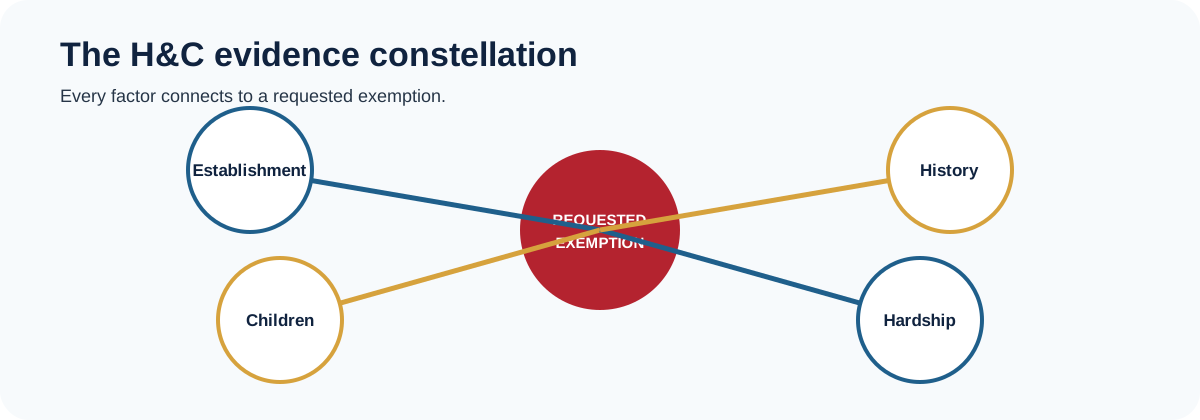
Identify the exemptions requested and organize evidence relevant to establishment, family circumstances, children’s interests, hardship and other case-specific factors.
- 03
Application preparation
Prepare consistent forms, documents and submissions without substituting general hardship statements for evidence.
- 04
Ongoing status and referral
Track status and enforcement separately. Refer a possible Federal Court judicial-review matter promptly to independent Canadian legal counsel.
In plain terms
What is an H&C application in Canada?
A humanitarian and compassionate application asks IRCC to grant permanent residence or an exemption from an immigration requirement because the person’s circumstances justify it. It is a discretionary process for a foreign national in Canada, not an appeal and not a way to extend temporary status.
The application must identify each exemption requested and prove the facts behind establishment, family circumstances, the best interests of affected children and other hardship. IRCC does not assess refugee protection under the H&C test. Filing also does not stop removal. Those limits need to be understood before a family spends money assembling a large record.
Who is this for?
You live in Canada and cannot use an ordinary permanent-residence class without an exemption. Your children’s lives, medical needs or education would be directly affected by removal. You have a long Canadian history that is supported by work, tax, family and community records.
An H&C application is unavailable while a refugee claim is outstanding and can be barred after some claim outcomes. Protection risk belongs on the refugee-claim page; a CBSA PRRA invitation belongs on the PRRA page. Federal Court questions require a lawyer.
What does an immigration officer check?
The officer checks whether you meet the legal requirements and whether the records support the application you submitted.
Is an H&C request legally available?
IRCC checks status, pending applications, refugee history and statutory bars before considering the factors.
A person cannot have two H&C applications under consideration or apply while a refugee claim is outstanding. A 12-month bar can follow a rejected, abandoned or withdrawn claim, subject to limited exceptions.
Which exemptions are being requested?
The application must name the requirements the person asks IRCC to waive.
A general plea for compassion leaves the decision-maker to guess. The forms and submissions should connect each legal obstacle to the facts and evidence relied on.
What does the record show about establishment?
IRCC looks at what the person has built in Canada and the circumstances behind it.
Time alone is not the case. Work, education, tax compliance, caregiving, community participation and family dependence need dates and documents.
How are children affected?
IRCC must give substantial attention to the best interests of a child directly affected.
The record should show the child’s age, needs, relationships, schooling, health and likely consequences. A parent’s hardship and a child’s interests overlap but are not identical.
Are hardship claims proved?
The decision-maker compares the stated consequences with personal records and current country information.
H&C does not decide the same protection risks as a refugee claim. Medical availability, family support and re-establishment difficulties must be tied to the requested exemption.
What evidence makes the application easier to assess?
Good evidence answers a specific concern and agrees with the forms, dates and amounts elsewhere in the file.
Canadian establishment
What it needs to prove: The person’s actual life, contribution and dependence in Canada.
What leaves questions: Ten support letters using the same general language.
What answers them: Tax, payroll, education, lease, caregiving and community records placed on a timeline.
Best interests of children
What it needs to prove: How a particular child would experience each possible outcome.
What leaves questions: A sentence that every child benefits from staying in Canada.
What answers them: School, medical, developmental and relationship evidence with a plan for both Canada and removal scenarios.
Hardship and re-establishment
What it needs to prove: What the applicant would actually face outside Canada.
What leaves questions: Country reports that do not mention the applicant’s region or circumstances.
What answers them: Personal medical, financial and family evidence connected to reliable current country information.
Immigration history and responsibility
What it needs to prove: Why status was lost or requirements were not met and what the person did afterward.
What leaves questions: Silence about refusals, unauthorized work or missed dates.
What answers them: Complete records, an accountable explanation and proof of later compliance where available.
A composite example
A parent has lived in Canada for seven years and says removal would be hard for two children. The first draft lists school marks and community activities but does not explain custody, the other parent or the child receiving therapy.
The family reorganizes the record around each child. School and clinical letters describe needs without offering immigration opinions. The parent provides the custody order, caregiving schedule and realistic plans for both possible outcomes. The evidence does not claim that a child decides the application; it gives IRCC facts for the required best-interests assessment.
What will it cost?
For applications received on or after 30 April 2026, IRCC lists CAD $660 for the H&C principal applicant processing fee and CAD $600 for the right of permanent residence fee, or CAD $1,260 together. Biometrics can add CAD $85. A spouse or partner and dependent children add separate fees.
Medical reports, translations, police certificates and expert evidence are third-party costs. Government processing fees may be partly refundable only in the circumstances IRCC states.
We quote after reviewing the exemptions, family group, immigration history and evidence volume. See our fees and cost guide.
How long can it take?
IRCC’s H&C estimate changes and does not protect temporary status or postpone removal. You control completeness, updates and replies. IRCC controls triage, background checks, requests and the decision.
Use the IRCC processing-time tool ↗. Anyone under a removal order needs separate, urgent advice; the H&C receipt is not a stay.

Why can an H&C application be refused?
A refusal often starts with a question the records did not answer. A new application should address that reason with changed evidence, not simply send the same file again.
The request does not identify the exemption needed
How to address it: State the legal obstacle and connect the requested exemption to the evidence.
Establishment is described but not documented
How to address it: Use a dated record of work, taxes, education, family care and community activity.
The child’s interests are treated as a slogan
How to address it: Show the individual child’s age, needs, relationships and consequences in each scenario.
Country hardship evidence is generic
How to address it: Connect reliable current material to the applicant’s location, health, family and resources.
The immigration history is incomplete
How to address it: Disclose status, claims, refusals and enforcement and explain conduct with records.
The application assumes filing stops removal
How to address it: Address enforcement and status through the correct separate process and legal advice.
What changed recently?
Rules and intake conditions can change. The application must use the requirements that apply on the day it is submitted.
Permanent-residence fees increased
The H&C processing fee became CAD $660 and the right of permanent residence fee CAD $600.
Read the IRCC source ↗IRCC updated the H&C application guide
The current guide keeps the one-application rule, bars and warning that filing does not delay removal.
Read the IRCC source ↗
What can you do yourself, and what can we do?
You can prepare and submit your own application. Professional help is useful when you want someone to test the evidence against the rules, identify gaps and put the scope in writing.
Do it yourself
You can identify the exemptions, order immigration records, create the chronology and gather evidence yourself. Use separate folders for establishment, each child, hardship and immigration history. Update IRCC when important facts change.
The assessment form can identify the service, but keep detailed medical and family evidence for a secure consultation.
Work with our office
We assess availability, bars and the requested exemptions, then test the evidence against the factors. Under a retainer, we prepare forms and submissions, organize exhibits and manage IRCC requests. We separate an H&C record from any protection or enforcement question.
We do not promise approval, present ordinary inconvenience as exceptional hardship or give Federal Court advice.
Where our work stops: We will not tell a person that filing H&C creates status or stops removal, and we refer court proceedings to independent Canadian legal counsel.
H&C application questions
Can I apply for H&C while my refugee claim is open?
No. IRCC states that a person with an outstanding refugee claim cannot submit an H&C application.
Does filing H&C stop removal?
No. IRCC continues removal unless another lawful process affects enforcement. Obtain urgent advice if CBSA is involved.
Do I need a Canadian child?
No, but IRCC must consider the best interests of any child directly affected. The rest of the H&C factors and evidence still matter.
How much establishment is enough?
There is no published number of years that guarantees approval. IRCC looks at the nature of the establishment, the circumstances and the whole record.
Can I submit a second H&C application?
A person may have only one H&C application under consideration at a time. A new filing also requires a fresh review of bars and circumstances.
Can your office challenge a refusal in Federal Court?
No. We can review the reasons and refer you promptly to independent Canadian legal counsel for court advice.
Prepared for licensee review by: Mohammadreza Nosraty, RCIC-IRB R507271
Update review due. Immigration rules may have changed since this page was reviewed. Confirm the current requirements in the official sources below or book advice before acting.
Official sources
The pages we checked when we last reviewed this program.