

Which intra-company transfer route are you assessing?
There are two legal starting points. Section 204(a) of the regulations covers work under relevant international agreements; section 205(a) covers work producing significant Canadian benefits. IRCC lists the agreements, including CUSMA and CETA, in its trade-agreement instructions.
Put the proposed legal basis at the top of your working notes. A comparison that starts with a permit code, without explaining why that route applies to the person and the companies, leaves the central question unanswered. Ask whoever prepares the file to identify the exact instruction they are using, rather than describe all transfers as one program.
The table below concerns the general, non-treaty route. It should not be used as a substitute for the agreement-specific review. Our business immigration page provides the broader service context; this article focuses on organising a transfer file.
| Starting question | Record in your notes |
|---|---|
| What is the legal basis? | The regulation and current instruction being assessed |
| Which companies are involved? | Each legal name, country and relationship |
| What job is moving? | Current role abroad and proposed Canadian role |
| What is being established? | An operating Canadian business or a new enterprise |
Does your company meet the multinational test?
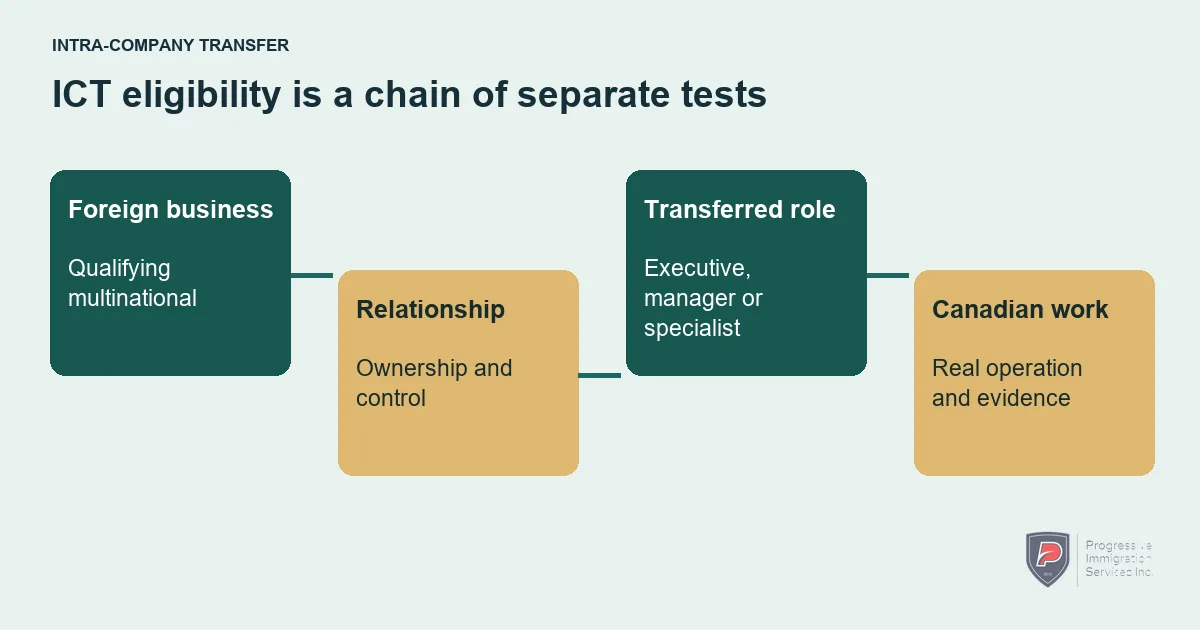
For a new Canadian enterprise under C61, IRCC requires an existing multinational with revenue-producing operations in its home country and at least one other country before the Canadian operation is established. A business operating only in its home country cannot use that new-office transfer to become multinational for the first time. This distinction comes from the ICT instructions, checked on 16 October 2026.
Build a country-by-country sheet before writing a narrative. Put the legal entity beside the activity you say it performs, then identify the records you would use to show that activity. Keep projected Canadian operations in a separate column from operations that already exist.
For example, a proposed overseas expansion and a completed overseas expansion are different entries in a business history. Label them accordingly. This is a planning example, not a client story or a statement that either structure qualifies.
Do the same with revenue claims. If a presentation says “international operations”, ask what transactions and business records support that description. A precise explanation of what exists is more useful than an impressive map with no evidence behind it.
How do you show that the companies are related?
IRCC identifies parent, subsidiary, branch and affiliate relationships, assessed through ownership and control. A customer relationship, licence or franchise agreement is not a replacement for a qualifying corporate relationship. See the relationship section of the official ICT instructions.
Draw the ownership structure on one page and attach a document reference to every connecting line. Keep percentages, voting arrangements and dates consistent with the corporate records. Where the structure changed, show the before-and-after position rather than leave the reviewer to reconstruct it.
A useful preparation folder might contain incorporation records, the shareholder register, relevant agreements and a short explanation of who makes decisions in each company. This is an organisational suggestion, not a universal document checklist. The documents needed depend on the structure being claimed.
If an acquisition is part of the story, identify the event date and which entity employed the transferee at each stage. Do not quietly replace the old employer’s name throughout the employment history. Ask the consultant to assess how the actual transaction affects the proposed route.
What must the employee and job records explain?
For the general ICT route, IRCC describes executive, managerial and specialised-knowledge roles and a continuous year of full-time work in a similar foreign role within the preceding three years. The instruction also requires a temporary transfer with a foreign position available for return.
Prepare a side-by-side description of the current and proposed work. Use ordinary verbs: approves budgets, supervises a department, sets policy or maintains a particular system. A title alone tells the reader little about how the job operates.
For a management role, sketch reporting lines and explain who performs the day-to-day work beneath that position. For specialised knowledge, identify the particular knowledge involved and the records that could demonstrate it. Avoid using a long résumé as the entire explanation of why this person is needed for this job.
Keep an employment timeline alongside these descriptions. Mark changes of employer, role or work pattern and gather the corresponding records. If there is a gap or an inconsistency, leave it visible for assessment rather than adjust dates to make the timeline look tidy.
What should a new-office plan actually show?
The ICT instructions require the proposed work to produce significant Canadian benefits within the permit period. They also exclude residential or virtual-mailing-address-only operations without physical commercial premises; a legitimate shared commercial space needs its own evidence. A new-office applicant may initially use counsel’s address while securing the premises described in the instruction.
Treat the business plan as a set of claims you can test against supporting material. Start with the proposed activities, then work through the resources each activity would need. Separate commitments already made from decisions that still depend on financing, premises or other arrangements.
Use a working table like this to prepare for the consultant’s review. Its purpose is to expose missing information; it is not an official scoring system and does not predict a decision.
| Proposed activity | Supporting material to identify | Question still to resolve |
|---|---|---|
| Begin supplying a product or service | Relevant contracts, orders or other business records | What exists now, and what is only forecast? |
| Use Canadian premises | Available lease or premises information | Does the space fit the proposed activity? |
| Hire or assign staff | Role descriptions and staffing budget | Who will do the work described? |
| Fund the operation | Financial records and funding arrangements | Which assumptions need explanation? |
Read the financial narrative against the staffing and premises sections. If one part of the plan assumes a large team while another budgets for a single employee, flag the difference. That is a preparation problem to resolve before submitting a polished document.
The significant-benefit evidence guide deals with a different business-owner route. Use it to understand that route’s evidence questions; do not copy its conclusions into an ICT file.
How long can the new-office permit last?
IRCC’s C61 instructions provide for a one-year new-office permit and an expected move to C62 or C63 for further work. A separate exception permits an additional six months where qualifying circumstances outside the applicant’s or employer’s control delayed establishment. The same official page must be read in full: its summary table is briefer than the later exception.
Do not build the business timetable around receiving an exception. Put the permit end date beside the operational milestones and identify when the next immigration review should occur. Describe what evidence you expect to have by that review, rather than write only “extend permit” in the calendar.
Keep a decision record for major changes to the plan. Note what changed, when the business learned about it and which supporting record belongs with the explanation. That makes a later review more accurate than a reconstructed timeline assembled from memory, particularly where different people handled premises, staffing and immigration preparation.
If a milestone slips, keep the contemporaneous records of what happened. Distinguish an external delay from a change in the business’s own plans. A consultant needs that distinction to assess the available next step; a revised forecast alone does not explain the history.
The site’s program-status page is a place to check dated program notices. Permit duration, processing time and permanent-residence eligibility are separate questions, so keep three separate entries in your planning notes.
Why do wages and the job offer need their own review?
Section 200(5) sets out the job-offer genuineness factors: the employer’s activity, reasonable employment needs, ability to fulfil the offer and compliance with employment and recruitment laws. Those questions should be addressed alongside the transfer criteria, not treated as an afterthought.
Check that the same job, workplace, wage and duties appear consistently across the business plan, offer and employment explanation. Where records serve different purposes, explain an apparent difference rather than assume the reader will understand it. Ask for a dated wage review under the exact instruction being used; this guide does not supply a universal salary figure.
IRCC’s genuineness guidance describes how officers assess offers and handle concerns. If a letter requests information, work from its actual wording and deadline. Keep the response question separate from your general business-planning notes.
Does an ICT work permit create a permanent-residence route?
A transfer permit and a permanent-residence application answer different legal questions. The Canadian Experience Class regulation excludes self-employment from the ordinary work-experience calculation. Do not assume an owner’s Canadian work counts because the permit says ICT or because the company produces payroll records.
Keep a separate permanent-residence worksheet for the person and, where relevant, their spouse or partner. Record the program being assessed, the experience claimed and any unresolved classification issue. This helps prevent the business plan from making an immigration promise that has not been examined.
IRCC decides the application on the evidence and applicable requirements. A consultation provides advice; representation requires a separate written retainer. Neither the company’s investment nor a permit label replaces that assessment.
What do owners ask about intra-company transfers?
Can I transfer myself because I own the foreign company?
Ownership alone does not establish ICT eligibility. The company structure, foreign operations, employment and proposed Canadian work must be assessed under the applicable route.
Is a new-office ICT the same as the Start-up Visa Program?
No. This article concerns a temporary work-permit category for a qualifying corporate transfer. Do not use the similar wording as evidence that the separate permanent-residence program is available.
Can the new-office permit simply be renewed?
Do not assume that. IRCC describes a move from C61 to another qualifying category, with a limited C61 exception for specified circumstances outside the applicant’s or employer’s control.
What should you bring to an initial review?
- A dated corporate structure chart and the records supporting it.
- A country-by-country account of existing business activity.
- The transferee’s employment timeline and proposed Canadian duties.
- The business plan, financial assumptions and premises information.
- Existing immigration documents and any correspondence or refusal.
- A short list of unresolved facts, including any permanent-residence assumptions.
These are preparation suggestions, not a replacement for the instructions and personalised document review. Keep originals intact and label any working summaries so they cannot be mistaken for source records.
Bring that material to a consultation to identify the evidence questions before proceeding.
General information only. Immigration requirements can change, and no outcome is guaranteed.
Official sources checked on October 16, 2026
- Official source · checked October 16, 2026 · page date 2026-10-15
- Official source · checked October 16, 2026 · page date 2026-10-15
- Official source · checked October 16, 2026 · page date 2025-01-15
- Official source · checked October 16, 2026 · page date 2025-01-06
- Official source · checked October 16, 2026 · page date 2025-01-06
- Official source · checked October 16, 2026 · page date 2025-01-06
- Official source · checked October 16, 2026 · page date 2025-01-06
- Official source · checked October 16, 2026 · page date 2025-01-06
- Official source · checked October 16, 2026 · page date 2026-10-15
- Official source · checked October 16, 2026
- Official source · checked October 16, 2026 · page date 2026-10-15
Continue reading
More in this topic
 16Oct
16OctEmployer work permits: IRCC job-offer fairness letters
IRCC can ask for more evidence when it doubts that an employer-specific job offer is genuine. Its current instructions, modified on 17 September 2026, describe a fairness letter and an employer response period of 15 days or the applicable office standard. Read the actual letter before responding: its concerns, deadline and delivery instructions matter. A letter gives an opportunity to answer concerns; it does not promise a work permit.
Read more 08Sep
08SepC11 work permits: building evidence of significant benefit
How entrepreneurs can connect the proposed work and Canadian benefit to records that an officer can verify.
Read more 04Sep
04SepStart-Up Visa is paused: what existing applicants should review
What the current Start-Up Visa pause means for new proposals and accepted applications.
Read more