

Sources checked October 16, 2026. The September 17 date on IRCC’s instructions is a page modification date, not proof that a new legal rule began that day.
A response process, not an approval timeline
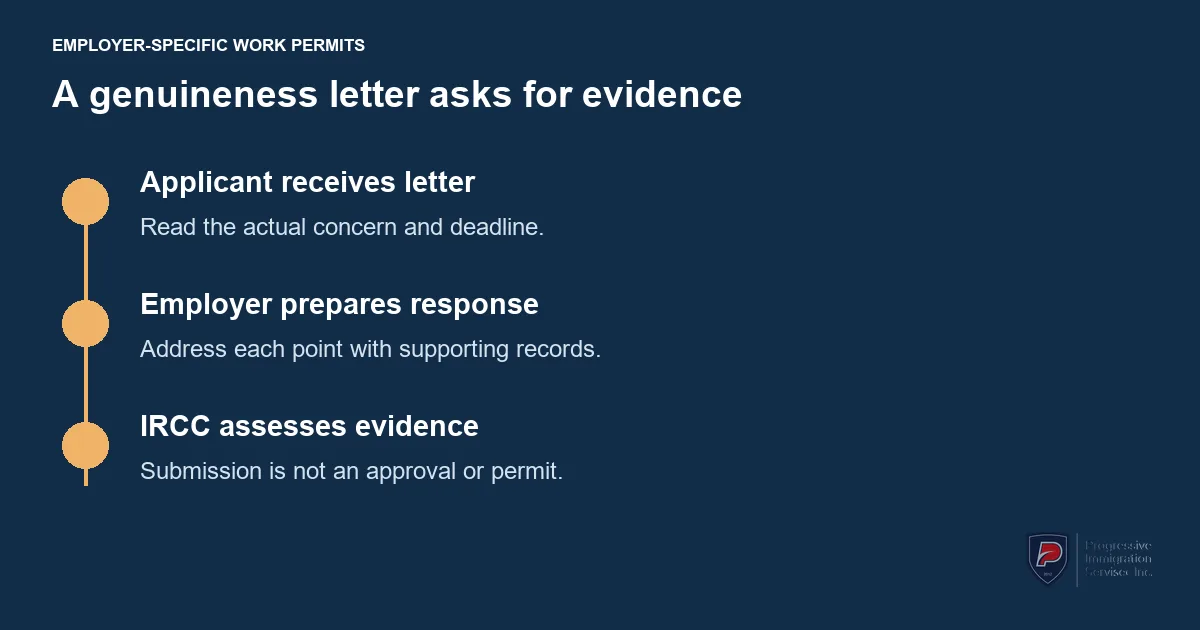
How does a job-offer concern move through the file?
-
Read the concern
The applicant receives the letter. Identify the reasons, requested evidence, deadline and submission instructions.
-
Separate responsibilities
Identify the employer’s evidence task and any instructions directed to the applicant. Do not assume one person’s action completes both.
-
Match records to questions
The employer checks what truthful records answer each concern and identifies gaps without inventing information.
-
Check and submit
The employer sends the requested evidence directly to IRCC using the method and deadline stated in the letter.
-
Keep the submission record
Retain the final response and any confirmation. Do not mistake an officer’s later follow-up for extra response time.
-
IRCC assesses the file
A response is considered with the application. A permit is not guaranteed; refusal remains possible if the officer is not satisfied.
This is an editorial preparation map. It does not mean every application receives a letter or that answering one leads to approval. Follow the actual request and current official instructions.
Which work permit applications does this concern?
IRCC’s job-offer genuineness instructions cover employer-specific applications under the Temporary Foreign Worker Program and the International Mobility Program, including renewals. Open work permits are outside this assessment. A positive labour market impact assessment, usually called an LMIA, does not remove IRCC’s separate assessment of the work permit.
That distinction matters when an employer believes the hiring process has already been checked. Keep the employer’s records and the worker’s application connected, while identifying which authority is asking the current question. A previous step should not be treated as an answer to a different request.
For wider route planning, see our business immigration and work-permit overview. This article concerns how to understand and organise an evidence response. It does not choose the correct permit route for a particular employer or worker.
What does a genuine job offer need to show?
Section 200(5) of the regulations sets out four factors. They concern the employer’s active business, its need for the position, its ability to meet the offered terms and past employment or recruitment-law compliance. These are not demonstrated new September 2026 criteria. The live-in-caregiver exception belongs to the active-business factor; it does not erase the remaining factors.
| Factor | Question to connect with the actual concern |
|---|---|
| Active business | Does the request question whether the employer is operating the business in which the job is offered? |
| Reasonable employment need | What work is the position intended to do, and how does the employer explain that need? |
| Ability to fulfil the offer | Which offered terms are questioned, and what records address the employer’s ability to meet them? |
| Past compliance | What concern is raised about the employer or recruiter’s employment and recruitment-law record? |
Start with the concern in the letter, rather than assembling every business document available. A record is useful when the reader can see what it establishes and why it is relevant. A large attachment without that connection can leave the original question unanswered.
For example, if the request questions the need for the position, an explanation should address the actual work and the employer’s circumstances. Merely repeating the job title does not explain the employer’s reasoning. Any records selected to support that explanation should be genuine, consistent with the existing file and responsive to the request. This is an organisation suggestion, not a statement that one particular document is required or sufficient in every case.
Related guide: building evidence of significant benefit for a C11 work permit. Significant benefit is a separate question; that guide does not replace the job-offer assessment or the instructions in a fairness letter.
Who receives the letter, and who sends the employer evidence?
IRCC’s instructions address the fairness letter to the applicant. The employer is asked to provide the requested evidence directly to IRCC, using the submission instructions. Keep those roles separate. The applicant receiving correspondence does not mean that an informal exchange with the applicant is the requested employer submission.
Read the letter once to understand the concern, then again to identify practical tasks. Copy the deadline exactly. Identify the person at the employer who will gather records and the person who will check the response before it is sent. Record any instructions directed separately to the applicant. Do not assume a response through one channel satisfies every instruction in the file.
Keep the complete letter beside the working list. If someone is helping prepare the material, give them the actual request and relevant earlier records instead of a shortened account of what another person thinks IRCC wants. A missing page or omitted instruction can change the question they are trying to answer.
The guidance distinguishes general concerns, where officers should send a fairness letter, from reliance on outside information the applicant would not reasonably know, where a letter and response opportunity must be provided. That distinction does not support saying every application universally must receive a letter or will be put on hold.
How can an employer organise a response?
A response organiser can help separate explanation, supporting material and unfinished work. It is a working aid, not an IRCC form or a substitute for the actual letter. Use the request’s own concerns as the starting point and keep any interpretation questions visible for the person reviewing the file.
Illustrative response organiser — editorial example, not an official form
One concern at a time
- Concern as written
- Record the relevant question from the actual letter and where it appears. Do not substitute a different, easier question.
- Explanation to check
- Identify what the employer can truthfully explain, who can verify it, and whether it agrees with the submitted information.
- Supporting record
- Give each selected document a clear label and note the part that relates to this concern. A label does not establish that the document is sufficient.
- Gap or inconsistency
- Record what is unavailable or does not agree. Do not fabricate a record, alter a historical fact or hide the issue in a larger attachment.
- Submission instruction
- Copy the method and deadline from the letter. Identify who is responsible for the employer’s direct submission.
- Final record
- Keep the checked response, documents actually sent and available submission confirmation together.
No employer, employee, signature or outcome is invented in this example. The employer must verify its own facts; the individual request determines what must be answered.
Use a separate entry when the letter raises more than one concern. A single document may help with several questions, but explain those connections rather than assuming the officer will reconstruct them. Check names, job details and dates against the earlier application material available to the employer and applicant.
Separate draft material from the final response. If several people are collecting information, identify the version being checked and which attachments belong to it. Keep originals intact. The purpose is to make the evidence understandable, not to create a more favourable history than the records support.
Does an officer’s follow-up period extend the response deadline?
The instructions describe an employer response period of 15 days or the applicable office standard. Read the actual letter for its deadline and handling instructions. Do not replace them with a general time period remembered from an article.
For the fallback webform procedure, the guidance also describes an additional 30-day officer follow-up period after the letter’s deadline, allowing the employer’s response to be attached to the application. This is not an extra 30 days for the employer to reply. Do not add the periods together and treat the result as a new response deadline.
If the deadline or delivery method is unclear, identify that as a question for the professional reviewing the actual letter. This guide establishes no entitlement to an extension and makes no promise that IRCC will hold every application. Keep the response date separate from an appointment date, the employer’s internal preparation dates and any later officer action.
What happens after a response, or if no response is received?
The request provides an opportunity to answer concerns; it is not itself the final refusal or an assurance of a permit. IRCC assesses the application using the information available. Where no response is received, the guidance describes assessment on that information and refusal if the officer remains unsatisfied about genuineness.
Keep a copy of what was actually sent. Distinguish an available submission confirmation from a conclusion about how IRCC will assess the material. If further correspondence arrives, read it as a new instruction instead of assuming the earlier response has settled the application.
For an intra-company transfer, the corporate and employment evidence also has its own requirements. Our ICT company and new-office guide explains that separate assessment. A permit label should not be treated as proof that a questioned job offer has been accepted.
What should you bring to an individual review?
Bring the full letter, job offer, available submitted application material and documents the employer proposes to use. Add a short chronology showing what was submitted and when. Keep missing records and unresolved questions separate from the items already collected so the reviewer can see the remaining work.
This guide does not describe a real client file or claim a consultant’s firsthand experience. Its organiser is an original teaching aid. An individual assessment must examine the actual instructions, facts and available records.
IRCC decides the work permit application. If Federal Court representation is needed, refer that separate matter to a lawyer. The Federal Courts representation rules also recognise that individuals may act in person, subject to the Rules. A consultant’s immigration authorisation should not be represented as Federal Court advocacy authorisation.
General information only. Requirements and instructions can change; no approval or other outcome is guaranteed.
Questions people ask
Does the letter mean my work permit has been refused?
A request to answer concerns is not itself the final refusal. Read the letter to identify the concern and the response it asks for.
Is 17 September 2026 a new legal start date?
The official instructions show that modification date. That alone does not establish when every paragraph was introduced or when a new legal obligation began.
Can I assume that the employer has 45 days?
No. The additional officer follow-up period described for the webform process is not an extension of the employer’s response deadline. Follow the actual letter.
Read the official-source summaries here
These original summaries explain why each source matters to this article. They are not government text or an individual eligibility decision. Expand a reference here; the optional original-source link opens a separate tab.
IRCC: job-offer concerns and employer responses
The instructions cover employer-specific work-permit applications, including renewals. They distinguish general concerns from outside information, identify the applicant as the letter recipient and describe employer evidence going directly to IRCC. The actual request and qualified response period matter. The separate officer follow-up interval is not extra employer response time, and a response does not guarantee a permit.
Checked October 16, 2026. Page modified September 17, 2026; that date alone does not establish a new law’s commencement.
Regulations: the four job-offer genuineness factors
Section 200(5) addresses active business, reasonable employment need, ability to fulfil offered terms and past compliance with employment and recruitment laws. The active-business factor contains a live-in-caregiver exception. Read the legal provision with the relevant current instructions; the table above is an editorial way to organise questions, not a replacement legal test.
Checked October 16, 2026. Page date October 15, 2026; consolidation current to September 30, 2026.
Federal Courts Rules: who may represent a party
Rules 119–121 address representation of parties. An individual may act in person subject to the Rules, or be represented by a solicitor. Consultant authorisation for immigration matters is not Federal Court advocacy authorisation. This article does not provide a litigation procedure or calculate court deadlines.
Checked October 16, 2026. Page date August 20, 2026.
Read the Federal Courts representation rules (opens a new tab)
Related reading
Related articles
 16Oct
16OctIntra-company transfer work permits: the company test
An intra-company transfer work permit depends on the businesses and the job, not simply on owning a foreign company. Start by identifying the legal route and showing how the proposed Canadian work fits it. This guide, researched on 16 October 2026, separates the multinational-company test from the new-office plan and gives you a way to organise the evidence before committing to a transfer. IRCC’s current ICT instructions are the starting point.
Read more 08Sep
08SepC11 work permits: building evidence of significant benefit
How entrepreneurs can connect the proposed work and Canadian benefit to records that an officer can verify.
Read more 04Sep
04SepStart-Up Visa is paused: what existing applicants should review
What the current Start-Up Visa pause means for new proposals and accepted applications.
Read more